Ripening wheat
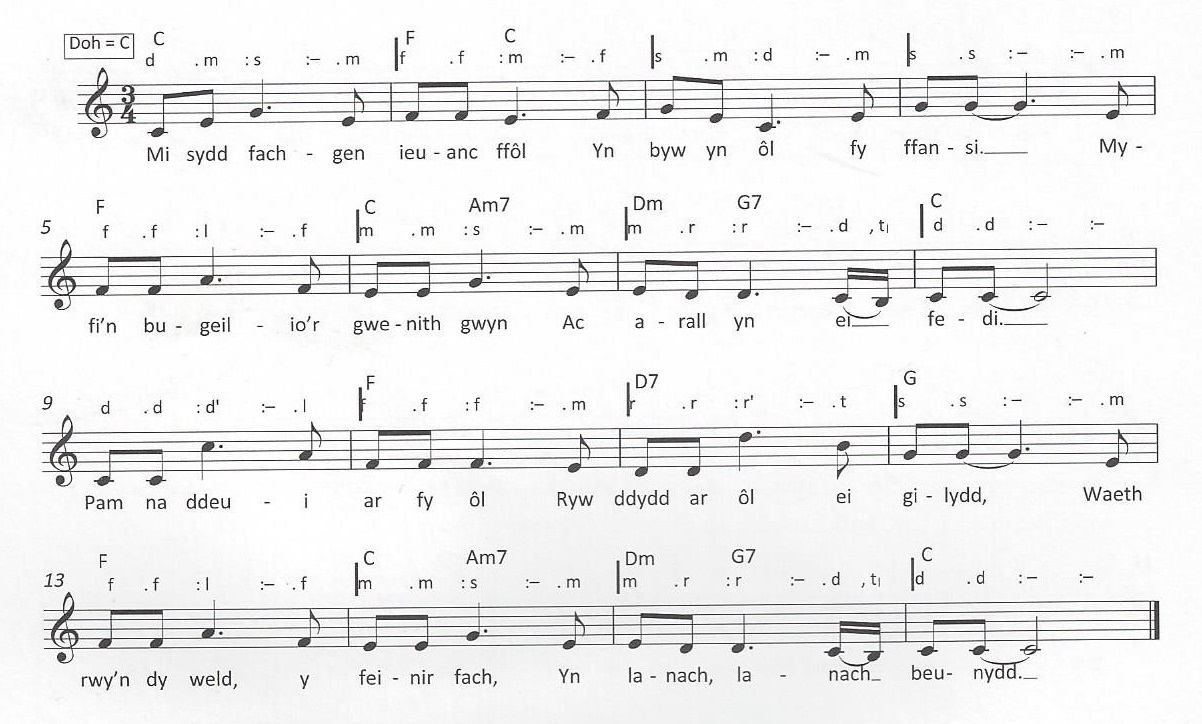
This is one of the best-known Welsh folk-songs, whose title translates as ‘Watching the White Wheat’. It was collected from oral tradition in the 1830s and first published in Maria Jane Williams’s collection, Ancient National Airs of Gwent and Morganwg (1844). It is a love-song, and has been linked to the popular, but rather dubious, tradition of a rich heiress, Ann Thomas (1704-27) — the so-called ‘Maid of Cefn Ydfa’, from the parish of Llangynwyd in central Glamorgan — being forced to marry against her will and dying of heartbreak for her true love, the somewhat nebulous poet, Wil Hopcyn (1700-41), to whom the song is attributed. Such a tradition is a common motif in folk literature, of course, with more than one example to be found in Glamorgan folklore alone. However, the song itself makes no explicit reference to the tale, and the version below mentions a Gwen rather than an Ann.
Lyrics
1. Mi sydd fachgen ieuanc ffôl			I am a foolish young boy
Yn byw yn ôl fy ffansi;				Living according to my fancy;
Myfi’n bugeilio’r gwenith gwyn,			It is I watching over the white wheat,
Ac arall yn ei fedi.				And another reaps it.
Pam na ddeui ar fy ôl,				Why do you not come after me,
Ryw ddydd ar ôl ei gilydd?			Some day after another?
Gwaith ’rwyn dy weld, y feinir fach,		Because I see you, little maiden,
Yn lanach, lanach beunydd.			More and more beautiful every day.

2. Glanach, glanach wyt bob dydd,		More and more beautiful are you each day,
Neu fi sy â’m ffydd yn ffolach;			Or it's I who'll be more foolish;
Er mwyn y Gwr a wnaeth dy wedd			For the sake of Him who made your looks
Gwna im drugaredd bellach.			Take pity on me at last.
Cwyd dy ben, gwêl acw draw,			Raise your head, look over there,
Rho i mi’th law wen dirion;			Give me your pretty white hand;
Gwaith yn dy fynwes bert ei thro		Because in your lovely breast
Mae allwedd clo fy nghalon!			Is the key to the lock of my heart!

3. Tra bo dwr y môr yn hallt,			While the water of the sea is salt,
A thra bo ’ngwallt yn tyfu,			And while my hair is growing,
A thra bo calon yn fy mron			And while there is a heart in my breast
Mi fydda’n ffyddlon iti;			I shall be faithful to you;
Dywed imi’r gwir dan gel			Tell me the truth in secret
A rho dan sêl d’atebion,			And give your answer under seal,
P’un ai myfi neu arall, Gwen,			Whether it is myself or another, Gwen,
Sydd orau gan dy galon.				Whom your heart prefers.

4. Codais heddiw gyda’r wawr,			I rose today with the dawn,
Gan frysio’n fawr fy lludded			Hastening greatly my fatigue
Fel cawn gusanu ôl dy droed,			So that I should be able to kiss your footsteps,
Ar hyd y coed yn cerdded:			Which have walked through the wood:
Cwyd fy mhen o’r galar maith			Raise my head from the long sadness
 serchus iaith gwarineb,			With the affectionate language of civility,
Gwaith mwy na’r byd i’r mab a’th gâr		Because more than the world to the boy who is your friend
Yw golwg ar dy wyneb.				Is looking on your face.
In Verse 2, some versions use “cwnn” or "cwn" (from cwnnu, to lift) rather than "cwyd” (to raise). In Verse 3, some versions mutate "bo" to "fo" after "tra", and some versions have "dan fy mron" rather than "yn fy mron".
The history of this song is very complicated. It is probably a medley of folk stanzas from a number of sources, ‘improved’ by Taliesin Williams (1787-1847) and lengthened with a verse composed by his father, ‘Iolo Morganwg’ (Edward Williams, 1747-1826). The latter was a wayward genius, who — under the influence of the love of his native Glamorgan, not to mention laudanum — rewrote the history of Welsh scholarship and literature with Glamorgan very much centre stage.
"Mi sydd" is an alternative form of "Dw i" (I am), stressing the fact that it is "I" being described. It should be followed by "yn" and a mutation, because "sydd" is derived from the verb "bod", but it is omitted here for scansion, and just the mutation of "bachgen" to "fachgen" remains.
"Myfi" is another stressed form of "I am", pronounced with the stress on "-fi".
"Deui" (mutated to "ddeui" after "na") comes from the verb "dod" (to come).
"'rwyn" is short for "Yr wyf yn", another literary form of "Dw i".
"gwna" is the command form of "gwneud" (to do, make) to someone familiar.
"gwêl" is the command form of "gweld" (to see) to someone familiar.
"rho i mi'th law" is an archaic form of "rho i mi dy law di".
Vocabulary
ieuanc young ("ifanc" locally)
ffôl silly, foolish
gwenith wheat (m)
medi to reap (cf. "Mis Medi" is "September")
gwaith because (more frequently seen meaning "work" or "occasion")
meinir maiden (f)
glân clean, beautiful (cf. "glan" meaning "shore")
beunydd daily, every day
er mwyn for the sake of
y Gwr God
gwedd countenance, complexion (f)
im short for "i mi"
trugaredd pity, compassion, mercy (m/f)
cwyd to raise
pellach at last, further
acw draw over there
tirion pretty
mynwes bosom, breast (f, mynwesau)
pert pretty, neat
tro can mean turn, change or time, but I don't know what it means in this context
allwedd key (f, allweddi; also "goriad")
clo lock (m, cleon)
tra while
hallt salty
dywed command form of "dweud" (to tell)
dan gel as a secret (from "celu" to hide)
sêl seal
p'un short for "pa un" (which one)
ai it is
brysio to hurry up
lludded fatigue (m, lluddedau)
ôl dy droed in your footspes (lit. after your feet)